Encyclopedia entry
Medial and Lateral Femoral Circumflex Arteries
Abstract
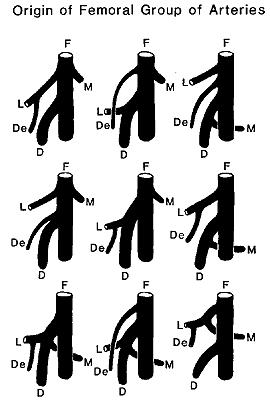
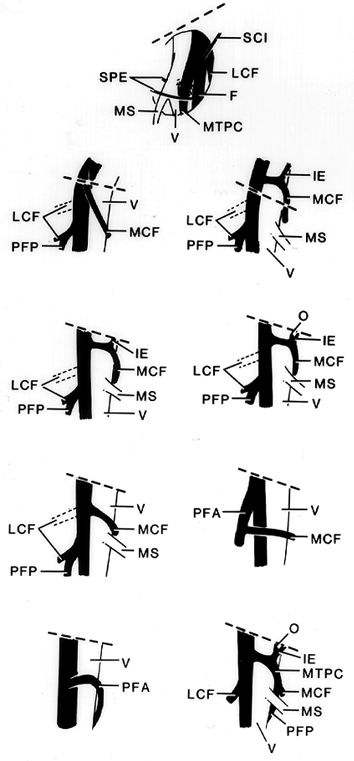
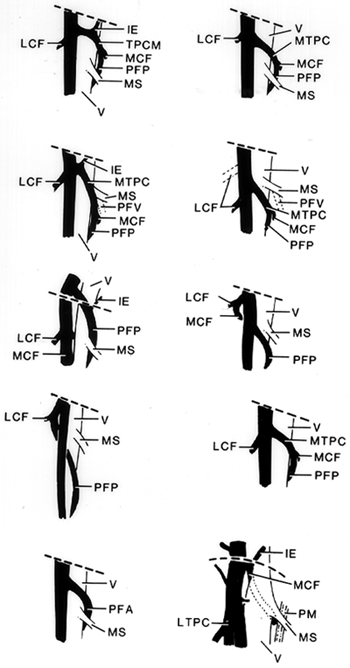
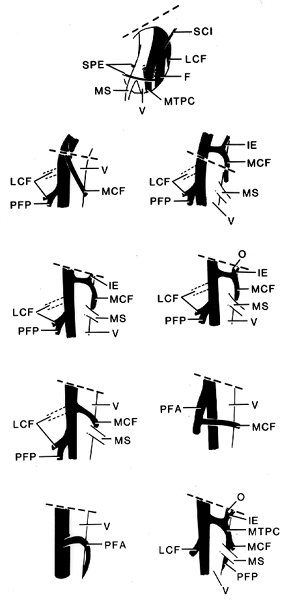
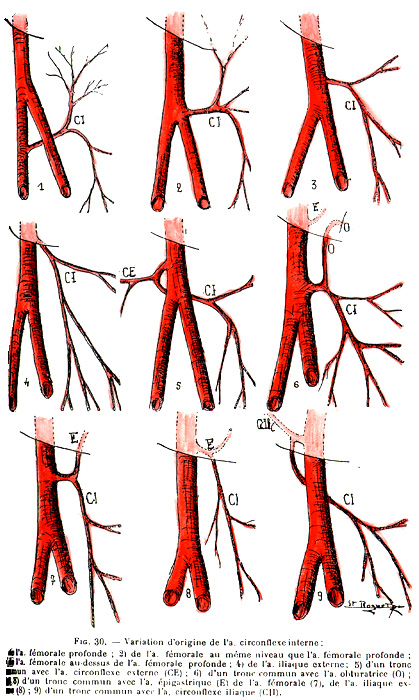
Variations of the medial femoral circumflex artery include the following. It may arise from the profunda femoris before the lateral circumflex; from the femoral artery, external iliac (2%) or one of its branches, or superficial epigastric; or from the the inferior epigastric artery or it may be the source of the inferior epigastric. The artery of ligamentum teres femoris arises from the medial femoral circumflex in about 15% of cases, from the obturator and medial circumflex via an anastomotic connection in about 24%, and from both arteries independently in about 7%.
Variations of the medial femoral circumflex artery include the following. It may arise from the profunda femoris before the lateral circumflex; from the femoral artery, external iliac (2%) or one of its branches, or superficial epigastric; or from the the inferior epigastric artery or it may be the source of the inferior epigastric. The artery of ligamentum teres femoris arises from the medial femoral circumflex in about 15% of cases, from the obturator and medial circumflex via an anastomotic connection in about 24%, and from both arteries independently in about 7%. The artery of the ligamentum teres may supply the head of the femur; but, in most subjects, it is absent or less important than the superior retinacular arteries, which are the most important arteries to the head of the femur. The inferior retinaculars are of subsidary importance.The medial femoral circumflex may give rise to a perforating artery. The medial femoral circumflex may be absent, in which case its defect is supplied by the obturator artery.
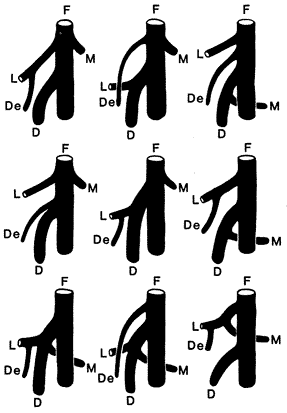
Variations of the lateral femoral circumflex include the following. It may arise from the femoral proximal to the origin of profunda femoris, or in common with the obturator. It may be doubled, with one branch from the femoral and one from the profunda, both from profunda, or both from the femoral proximal to profunda. The lateral femoral circumflex is made up of a number of separate arteries, which are represented by a common stem in 72-75%. The lateral femoral circumflex may give rise to an obturator. This artery has been found taking a superfical course after arising from a superficial femoral artery.
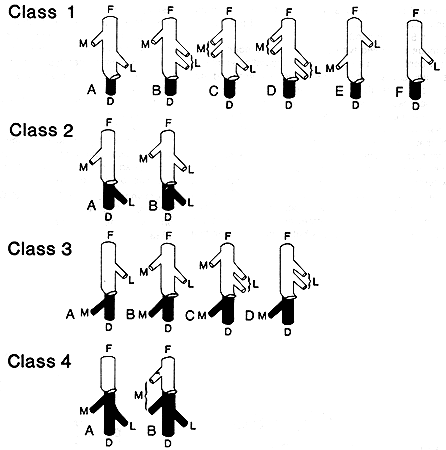
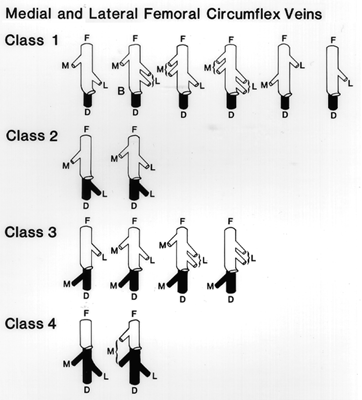
As indicated above, one of the circumflex arteries (more frequently the medial femoral circumflex) may arise independently from the femoral, and the point of origin of the independent vessel, may be either above or below that of the profunda. When the medial femoral circumflex is the independent vessel, its origin is most frequently above that of the profunda (with an independent medial femoral circumflex, the origin of the profunda is apt to be somewhat below the usual point). With a high origin of the profunda, the lateral femoral circumflex may be represented by two vessels, one arising from profunda, the other (accessory) arising from the femoral distally.
Occasionally, both circumflexes arise independently from the femoral, the profunda in such cases usually having a low origin, and one of the perforating arteries may arise from the circumflexes.
An extreme case of this, representing an almost dissolution of the profunda, has been reported by Ruge. In this case, the superior perforating arises from the medial femoral circumflex and the middle perforating from the lateral femoral circumflex; what may be termed the profunda arises 9.7 cm below the inguinal ligament and provides only the inferior perforating artery.
The medial femoral circumflex may be very much reduced in size or even absent, its territory being supplied by branches from the obturator artery. The medial femoral circumflex may arise from the external iliac (2% of cases, Lipshutz), from the inferior epigastric (Fischer, 1827), or may be the source of the inferior epigastric (Reid, 1836).
Rarely, one of the perforating arteries arises directly from the femoral, and a similar origin has also been observed for the descending branch of the lateral femoral circumflex.
It has been shown (Auburtin, 1905) that the lateral femoral circumflex is made up of a number of separate arteries that are represented by a common stem in 72% of cases (Lipshutz, 1915 reported 75%).
The lateral femoral circumflex may give rise to the obturator artery.
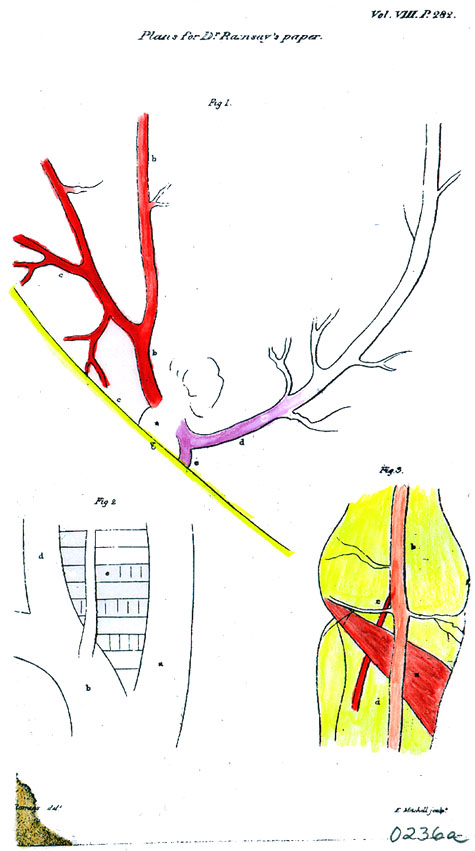
The lateral femoral circumflex may take a superficial course . It may also arise from the superficial femoral.
No side or sex differences have been reported for either the lateral or medial femoral circumflex arteries.
Lateralis:
Anatomy Atlases. Image hosted by the site it comes from. Open the original page.
Lateralis:
Anatomy Atlases. Image hosted by the site it comes from. Open the original page.
Lateralis:
Anatomy Atlases. Image hosted by the site it comes from. Open the original page.
See , , , , , , , , , See
Anatomy Atlases. Image hosted by the site it comes from. Open the original page.
Anatomy Atlases. Image hosted by the site it comes from. Open the original page.
Anatomy Atlases. Image hosted by the site it comes from. Open the original page.
Anatomy Atlases. Image hosted by the site it comes from. Open the original page.
Anatomy Atlases. Image hosted by the site it comes from. Open the original page.
Anatomy Atlases. Image hosted by the site it comes from. Open the original page.
Anatomy Atlases. Image hosted by the site it comes from. Open the original page.
Anatomy Atlases. Image hosted by the site it comes from. Open the original page.
Medial Femoral:
See , 28 , 128A , 128B , 360 , 264A , 264B , 360x , 377 ,
Anatomy Atlases. Image hosted by the site it comes from. Open the original page.
Riferimenti dell’opera originale
Elenco riportato come compare nella fonte, senza normalizzazione dei formati bibliografici.
- Anson, B.J., Ed. (1966) Morris' Human Anatomy, 12th ed., The Blakiston Division, McGraw-Hill Book Company, New York.
- Auburtin, G. (1905) Die beiden Arteriae circumflexae femoris des Menschen. Anat. Anz. 27:247-269.
- Bergman, R.A., Thompson, S.A., Afifi, A.K. and F.A. Saadeh. (1988) Compendium of Human Anatomic Variation: Catalog, Atlas and World Literature. Urban & Schwarzenberg, Baltimore and Munich.
- Chandler, S.B. and P.H. Kreuscher. (1932) A study of the blood supply of the ligamentum teres and its relation to the circulation of the head of the femur. J. Bone Joint Surg. 18:834-846.
- Chang, S.C., Chen, E.Y. and W.L. Sung. (1963) Observations on the deep and circumflex femoral arteries in Chinese. Acta Anat. Sinica 8:282-292.
- Dschau, F. (1936-37) Eine bisher umbekannte Varietät der Arteria obturatoria und pudenda accessoria mit einer Varietät der A. circumflexa femoris medialis. Anat. Anz. 83:25-29.
- Fischer, -. (1827) Un exemple très-rare d'une variété d'origine de la artère circonflexe interne. Bull. et Mém. de la Soc. Anatomique de Paris 1827:18-19.
- Gruber, W. (1867) Enorm hoher Ursprung einer supernumerären Arteria circumflexa ilei interna von der Arteria iliaca externa. Arch. Anat. Physiol. Wissen Med. 1867:547-551.
- Poynter, C.W.M. (1922) Congenital anomalies of the arteries and veins of the human body with bibliography. University Studies of the University of Nebraska 22:1-106.
- Ramsay, A. (1813) Account of unusual conformation of some muscles and vessels. Edinburgh Medical and Surgical Journal 8:281-283.
- Schaefer, E.A., Symington, J, and T.H. Bryce. (1915) Quain's Anatomy, 11th ed., Longmans, Green and Co., London.
- Senior, H.D. (1919) The development of the arteries of the lower extremity. Am. J. Anat. 25:55-95.
- Senior, H.D. (1924) The description of the larger direct or indirect muscular branches of the human femoral artery: A morphogenetic study. Am. J. Anat. 33:243-266.
- Shepherd, F.J. (1883) On some anatomical variations: Common iliac arteries. Annals of Anatomy and Surgery. 8;175-177.
- Srb, J. (1860) Ueber das Verhalten der Arteria profunda femoris. Oesterreichische Zeitschrift für practische Heilkunde VI: 1-16.
- Stieda, H. (1892) über die Arteria circumflexa ilium. Anat. Anz. 7:232-246.
- Thomson, A. (1883) Origin of the internal circumflex from the deep epigastric artery. J. Anat. Physiol. 18:379-383.
- Williams, G.D., Sindelar, R.J., Peart, J.C., Martin, N.A., McIntire, L.R. and C.H. Martin. (1930) Origin of the deep and circumflex femoral group of arteries. Anat. Rec. 46:273-279.
- Williams, G.D., Martin, C.H. and L.R. McIntire. (1934) Origin of the deep and circumflex femoral group of arteries. Anat. Rec. 60:189-196.
Anatomical classification
- Systems:
- Cardiovascular system
Content provenance
Adaptation
Adaptation of «Medial and Lateral Femoral Circumflex Arteries — Illustrated Encyclopedia of Human Anatomic Variation: Opus I: Muscular System» by Ronald A. Bergman, Adel K. Afifi, Ryosuke Miyauchi. Source: https://www.anatomyatlases.org/AnatomicVariants/Cardiovascular/Text/Arteries/FemoralCircumflexMedLat.shtml Original work distributed under the CC BY-NC-SA 4.0 licence (https://creativecommons.org/licenses/by-nc-sa/4.0/deed.it). Adaptation by Redazione AIVA. Changes from the original: Testo originale inglese riprodotto integralmente e riorganizzato nel formato scheda del portale (sintesi, testo, riferimenti), senza modificarne le affermazioni. La traduzione italiana non è ancora stata eseguita, e la pagina lo dichiara. Le figure non sono state copiate: sono collegate alla pagina d’origine. This publication is not approved or endorsed by the authors of the original work.
Licence
This content is distributed under the licence CC BY-NC-SA 4.0. Licences and attribution