Encyclopedia entry
Cystic Artery
Abstract
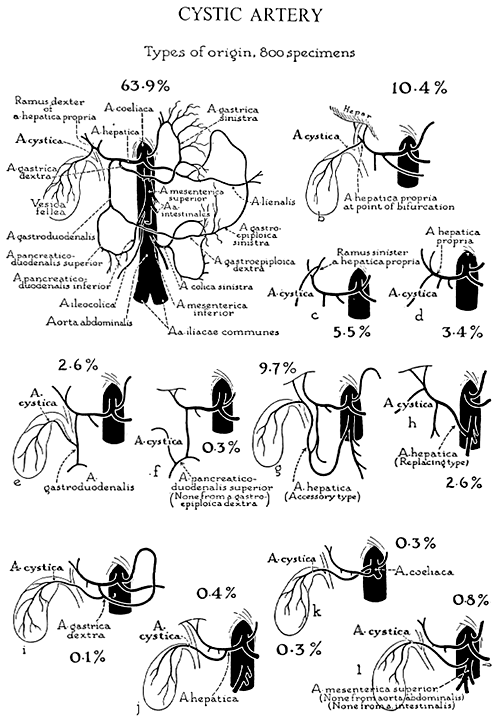
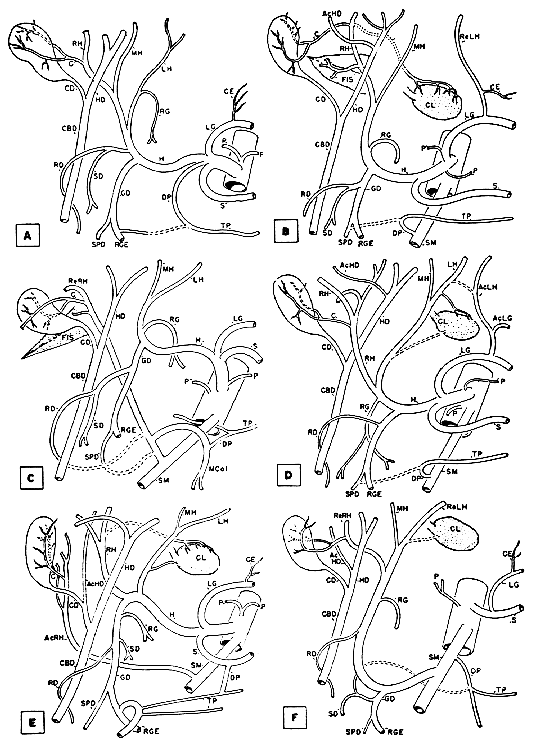
See also hepatic artery above for additional text and references. Anson studied the cystic artery in detail and the results of that study follow: "The primary source of the cystic arteries is still of the classical variety, that is to say, they arise from the closest possible source (the right ramus of the hepatic artery proper). This form is the most common. Other sources occur - to make a total of twelve types encountered in a study of 800 specimens. The twelve types fall conveniently into four categories: Group I.
See also hepatic artery above for additional text and references.
Anson studied the cystic artery in detail and the results of that study follow:
"The primary source of the cystic arteries is still of the classical variety, that is to say, they arise from the closest possible source (the right ramus of the hepatic artery proper). This form is the most common. Other sources occur - to make a total of twelve types encountered in a study of 800 specimens. The twelve types fall conveniently into four categories:
Group I. The cystic artery artery arises from a ramus of the proper hepatic artery, or from the latter at the point of division, or from the same vessel proximal to the point of division, or from the same vessel proximal to the point of bifurcation (a to d). In succession, and in the order of decreasing frequency, these are: from the right ramus of the hepatic proper in 63.9%; at the latter vessel at the point of bifurcation in 10.4%; from the left ramus in 5.5%; and from the hepatic artery proper, proximal to the point of bifurcation, in 3.4%. Totally, 83% for the four near source-vessels.
Group II. To a second category may be assigned those specimens in which the cystic artery takes origin from the downward-directed vessel, the gastroduodenal artery, or the latters branch, the superior pancreaticoduodenal (figs. e and f). Origin from the more distant source is far less common (0.3%) than the nearer (2.6%).
Group III. A third general group belong those specimens in which the immediate source of the cystic artery matches the regular pattern which exists in the cases illustrated in the first category, but differs from them in the deviation of the parent vessel (figs. g and h). The parent stem may be the superior mesenteric in each, but the hepatic artery itself may be either an accessory artery or a replacing one. Together, these instances (9.7% and 2.6%) make up a total of 12.3%. From the point of view of nearness of source to area of supply, these cases could be regarded as belonging to Group I (to make a combined total of 95.5%).
Group IV. To the fourth category may be assigned those specimens in which the cystic artery is "moved," so to speak, toward the aorta. These have been observed in four types: from the right gastric in 1 case (fig. i); from the hepatic artery near the celiac source in 3 cases (fig. j); from the celiac itself in 2 cases (fig, k); and from the superior mesenteric in 6 instances (fig, 1). Together these cases make a total of only 12."
Anson continues with the following conclusion: Presented in this segregated way, the variations described above tend to appear somewhat less critical than they actually are, since, in the structure of any individual patient, unexpected arrangements in the biliary duct-system may accompany equally unpredictable patterns of vascularity- even to the occurrence of a portal vein in a position anterior to the hepatic artery and the common bile duct, together with a cystic artery derived from a distant source and a supernumerary hepatic artery of large caliber. This means, obviously, that there can be no substitute for full exposure of the extra-hepatic element of the so-called "triad" and of the accessory structure - which may be arteries, veins, or ducts, or these in combination."
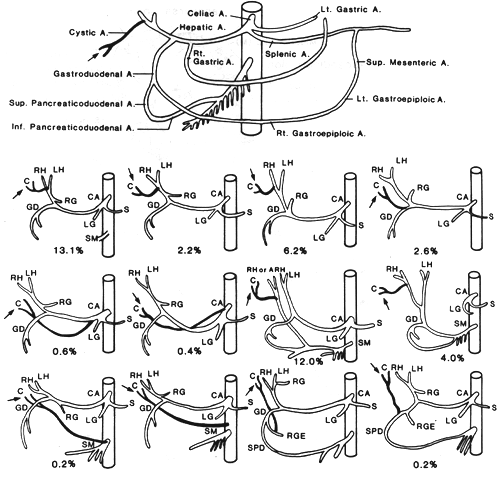
Gastroduodenal
Anatomy Atlases. Image hosted by the site it comes from. Open the original page.
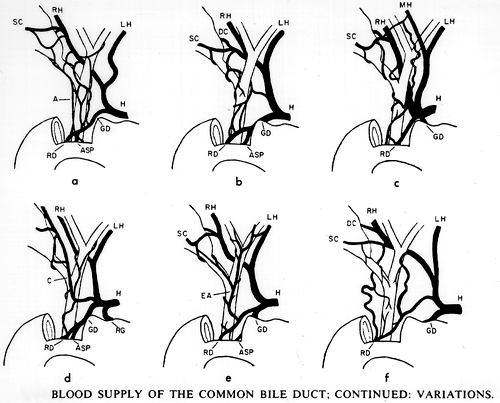
Gastroduodenal
Anatomy Atlases. Image hosted by the site it comes from. Open the original page.
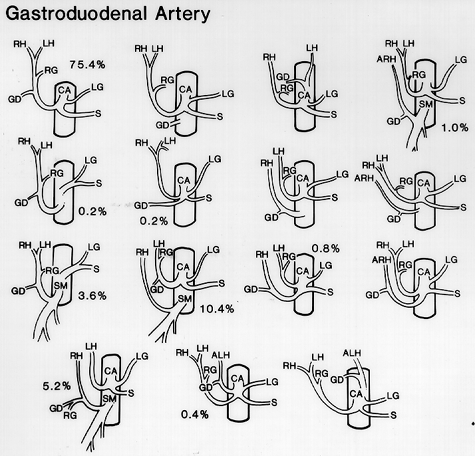
Gastroduodenal
Anatomy Atlases. Image hosted by the site it comes from. Open the original page.
Pancreatoduodenal, Superior
Anatomy Atlases. Image hosted by the site it comes from. Open the original page.
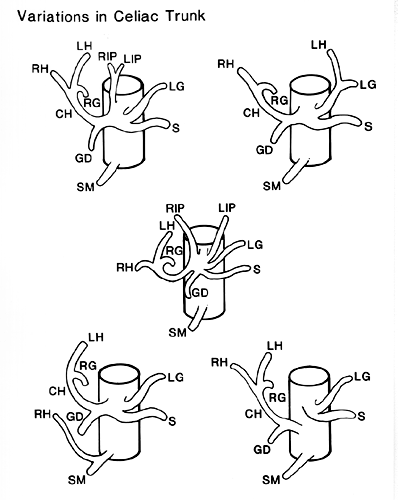
Pancreatoduodenal, Superior
Anatomy Atlases. Image hosted by the site it comes from. Open the original page.
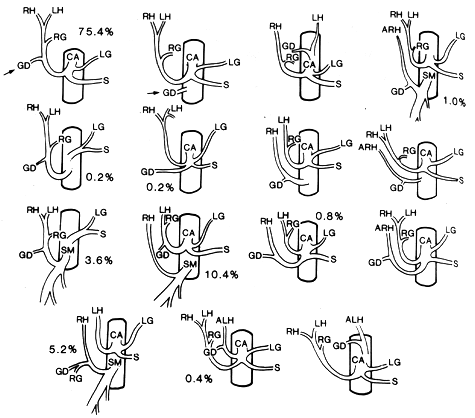
Pancreatoduodenal, Superior
Anatomy Atlases. Image hosted by the site it comes from. Open the original page.
Pancreatoduodenal, Superior
Anatomy Atlases. Image hosted by the site it comes from. Open the original page.
See Image 101
Reference Anson, B.J. Anatomical considerations in surgery of the gall-bladder. Q. Bull. Northwestern University Medical School 30:250-259.
Numerous additional references may be found with the Hepatic Artery .
Anatomical classification
- Systems:
- Cardiovascular system
Content provenance
Adaptation
Adaptation of «Cystic Artery — Illustrated Encyclopedia of Human Anatomic Variation: Opus I: Muscular System» by Ronald A. Bergman, Adel K. Afifi, Ryosuke Miyauchi. Source: https://www.anatomyatlases.org/AnatomicVariants/Cardiovascular/Text/Arteries/Cystic.shtml Original work distributed under the CC BY-NC-SA 4.0 licence (https://creativecommons.org/licenses/by-nc-sa/4.0/deed.it). Adaptation by Redazione AIVA. Changes from the original: Testo originale inglese riprodotto integralmente e riorganizzato nel formato scheda del portale (sintesi, testo, riferimenti), senza modificarne le affermazioni. La traduzione italiana non è ancora stata eseguita, e la pagina lo dichiara. Le figure non sono state copiate: sono collegate alla pagina d’origine. This publication is not approved or endorsed by the authors of the original work.
Licence
This content is distributed under the licence CC BY-NC-SA 4.0. Licences and attribution