Voce enciclopedica
Hypoglossal (CN XII) Nerve
Abstract
A number of variations in the course and branches of this nerve have been reported. The nerve may have a posterior (dorsal) root bearing a ganglion reminiscent of its embryologic origin (like a spinal nerve). The hypoglossal nerve has been reported to exit from the posterior surface of the medulla oblongata instead of its usual exit anteriorly.
A number of variations in the course and branches of this nerve have been reported. The nerve may have a posterior (dorsal) root bearing a ganglion reminiscent of its embryologic origin (like a spinal nerve).
The hypoglossal nerve has been reported to exit from the posterior surface of the medulla oblongata instead of its usual exit anteriorly.
In some cases, instead of coursing dorsal to the vertebral artery, the rootlets of the nerve, upon leaving the medulla oblongata, lie on either side of the artery (artery passing between rootlets), lie anterior to the artery, or pass through an annulus of the vertebral artery.
The right and left nerves may be connected by crossing fibers situated between the genioglossus and the geniohyoid muscles or in the substance of the geniohyoid (ansa suprahyoidea hypoglossi of Hyrtl). The reported frequency is 8-10% of individuals.
The hypoglossal nerve has been reported to carry sensory fibers which supply the tip of the tongue.
The hypoglossal may send branches to one or more of the following muscles: mylohyoid, diagastric, and stylohyoid.
In some cases, the descendens hypoglossi (C1 and C2) is carried partly or totally by the vagus nerve. The origin of fibers, in either case, remains the first and second cervical nerve. The descendens hypoglossi may send branches to the thorax, where it joins either the vagus nerve or the sympathetics. The origin of these branches is probably either vagal or sympathetic fibers that have joined the descendens hypoglossi. The descendens hypoglossi occasionally sends a branch to the sternal head of the sternocleidomastoid muscle.
Branches from the hypoglossal have been interpreted as consisting of aberrant vagal nerve fibers.
The ansa hypoglossis may be absent.
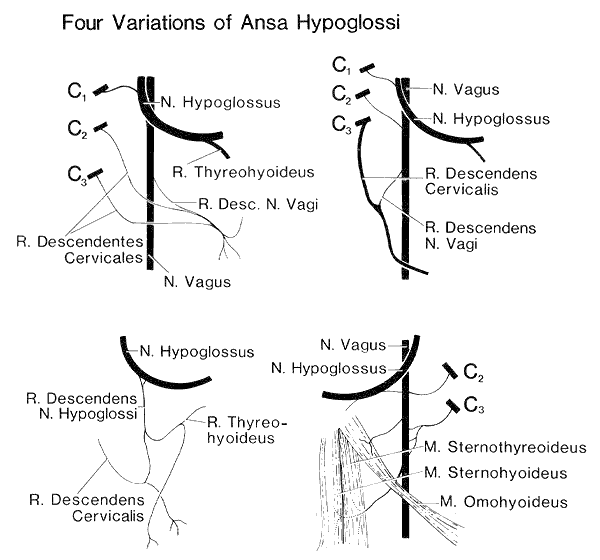
Anatomy Atlases. Immagine ospitata dal sito d’origine. Apri la pagina originale.
Riferimenti dell’opera originale
Elenco riportato come compare nella fonte, senza normalizzazione dei formati bibliografici.
- Bautzmann, H. (1930) Verlauf des Nervus cutaneous colli durch eine Insel der Vena jugularis externa. Anat. Anz. 70:516-519.
- Betti, U.A. (1897) Des connexions du nerf hypoglosse avec les nerfs cervicaux. Arch. Ital. Biol. 28:156-159.
- Chiarugi, G. (1889) Sur l'existence d'une racine dorsale rudimentaire avec ganglion pour le nerf hypoglosse chez l'homme. Arch. Ital. Biol. 11:421-422.
- Fitzgerald, M.J.Y. and M.E. Law. (1958) The peripheral connexions between the lingual and hypoglossal nerves. J. Anat. 92:178-188.
- Fróes da Fonseca, A. (1922) Beobachtung einer Anastomose zwischen Glossopharyngeus und Hypoglossus. Anat. Anz. 55:551-553.
- Jameson, R.M. and W.O. Reinhardt. (1947) The supra-hyoid hypoglossal ansa (of Hyrtl):A nerve crossing the midline of the body. Anat. Rec. 97:392-393.
- Kubik, W. (1963) Ansa suprahyoidea hypoglossi. Folia Morphol. 22:253-256.
- Latarjet, A. (1948) Testut's Traité d'Anatomie Humaine, 9th ed. G. Doin & Cie., Paris.
- Lippmann, R. von. (1910) Abnormer Ursprung des Ramus descendens N. hypoglossi aus dem N. vagus. Anat. Anz. 37:1-4.
- Macalister, A. (1877) Notes on some anomalies in the course of nerves in man. Proc. Royal Irish Academy, Dublin 2:426.
- Mouchet, A. (1909) Absence de l'anse de l'hypoglosse. Bibliographie Anatomique 19:238-241.
- Platzer, W. (1959) Eine transmediane Anastomose der beiden Nn. hypoglossi. Arch. Psychiatr. Nervenkr. 199:372-376.
- Rodrigues, A. (1930) Le descendens cervicalis chez l'homme et chez les mammiféres (quelques notes sur son évolution phylogénique). Assoc. Anatomistes Comptes Rendus 25:267-282.
- Schaefer, E.A., Symington, J. and T.H. Bryce., Eds. (1915) Quain's Anatomy, 11th ed., Longmans, Green, and Co., London.
- Turner, W. (1893) A phrenic nerve receiving a root of origin from the descendens hypoglossi. J. Anat. Physiol. 27:427.
- Willm, A. (1928) Absence totale de l'anse de l'hypoglosse, les nerfs des muscles soushyoidiens naissant en apparence de pneumogastrique. Ann. Anat. Pathol. 5:580-582.
- Wimmer, A. (1958) Einige darunter seltene Nervenvariationen des Halsgebietes A. Vier Variationen der Ansa nervi hypoglossi. B. Verlauf des Nervus accessorius durch ein "Knopfloch" der Vena jugularis interna sinistra. Anat. Anz. 105:391-399.
- Winckler, G. (1955) Apropos des relations que existent entre le plexus cervical et le nerf grand hypoglosse. Assoc. Anatomistes Comptes Rendus 42:1415-1419.
- Wischnewsky, A.S. (1930) Die Aufbautypen des Ramus descendens nervi hypoglossi. Z. Anat. Entwicklungsgeschichte 92:551-564.
Classificazione anatomica
- Sistemi:
- Sistema nervoso
Provenienza del contenuto
Adattamento
Adattamento di «Hypoglossal (CN XII) Nerve — Illustrated Encyclopedia of Human Anatomic Variation: Opus I: Muscular System» di Ronald A. Bergman, Adel K. Afifi, Ryosuke Miyauchi. Fonte: https://www.anatomyatlases.org/AnatomicVariants/NervousSystem/Text/HypoglossalNerve.shtml Opera originale distribuita con licenza CC BY-NC-SA 4.0 (https://creativecommons.org/licenses/by-nc-sa/4.0/deed.it). Adattamento a cura di Redazione AIVA. Modifiche rispetto all’originale: Testo originale inglese riprodotto integralmente e riorganizzato nel formato scheda del portale (sintesi, testo, riferimenti), senza modificarne le affermazioni. La traduzione italiana non è ancora stata eseguita, e la pagina lo dichiara. Le figure non sono state copiate: sono collegate alla pagina d’origine. Questa pubblicazione non è approvata né avallata dagli autori dell’opera originale.
Licenza
Questo contenuto è distribuito con licenza CC BY-NC-SA 4.0. Licenze e attribuzioni